Our family budget · November 2026 estimates · Lisbon area
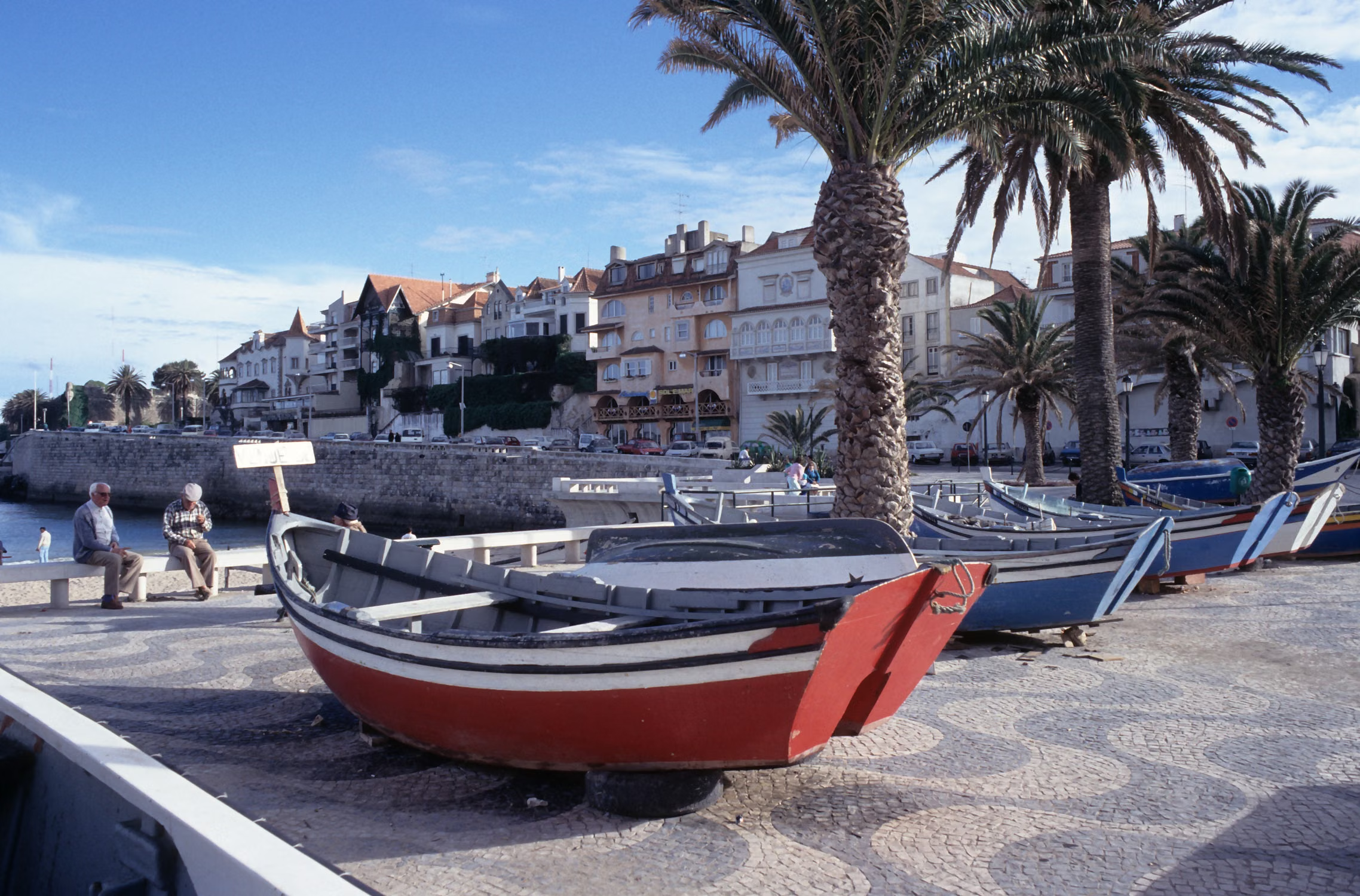
Cascais waterfront. Photo by Carlo Primo / Pexels. Illustrative stock photo.
Spoiler: It’s not €2,000 a month. Not even close.
When people hear that we retired early and moved to Portugal, I think some imagine us living a charming little European life where everything costs half as much as America. Fresh bread for 50 cents. A glass of wine for €2. Endless sunshine. Financial independence on a shoestring. I mean, the bread is pretty affordable.
But the rest?
Well, our listed expenses come to roughly €10,300 to €10,700 a month for our family of four in Portugal, including school and a travel allowance. Yes, really.
Before you close this tab and decide Portugal is only for millionaires, hear me out. We aren’t trying to keep every expense to a minimum. We bought a comfortable home, send our boys to international school, and make room for travel.
We retired early and moved from the Seattle area to Portugal in 2022 with our two boys. We’ve since bought a home, enrolled our children in international school, joined a fancy gym, bought an electric car, and taken advantage of our new European location to travel. We live a comfortable life, and we make choices that certainly aren’t the least expensive options available.
But here’s the interesting part: some things in Portugal are dramatically less expensive than what we experienced in the United States. Others are about the same. And a few might make your eyes water. So I’m opening up our actual household expense sheet. Let’s talk about where the money goes, what we think is worth paying for, and whether Portugal is really cheaper than America.
Illustrative monthly averages from our November 2026 household estimates. Food uses the midpoint of our grocery range. Travel uses a €20,000 annual allowance. Rounded labels; this is our family’s spending, not a Portugal-wide average.
Find a cost or skip to the full budget
What does €10,000 a month actually buy us?
Before we dive into the details, here’s what our life looks like. We’re a family of four living in the Lisbon area. Our two boys attend private international school. We own our home and have a mortgage. We drive a fully electric BYD, have private health insurance, and belong to Holmes Place, a rather swanky gym.
Our oldest is involved in School of Rock, where he has a private music lesson and plays in a band each week. The kids have sports and other activities. We eat well, occasionally order food when nobody feels like cooking, and go out to restaurants. And we travel. A lot more than we did when we lived in America. This is not a minimalist retirement budget. It’s the cost of the life we’ve chosen.
And because we retired young with two kids still at home, our expenses look very different from those of a retired couple whose children are grown. Let’s get into it.
Housing: €2,575 a month
Our mortgage costs €2,200 per month. On top of that, we pay:
| Expense | Monthly |
|---|---|
| Mortgage | €2,200 |
| Condominium fees | €150 |
| Homeowners insurance | €60 |
| Mortgage life insurance | €65 |
| Property tax (IMI), averaged monthly | €100 |
| Total | €2,575 |
We pay roughly €1,200 per year in property tax, spread across three payments. The €100 in the table is a monthly allowance, not a monthly bill. And here’s something interesting: our mortgage payment in Portugal is pretty similar to what we were paying in the Puget Sound area. Moving overseas didn’t magically make our housing inexpensive.
We chose a larger, comfortable home because that’s how we want to live. There are absolutely less expensive options in Portugal. One part of Portuguese homeownership I’m not particularly fond of? Mortgage life insurance. Our mortgage arrangement includes life insurance intended to repay the covered mortgage balance if a covered death or disability occurs, subject to the policy’s terms. That’s a reassuring safety net, especially for a family.
But the cost can increase as we get older. It’s actually made us question whether we should pay off our mortgage early. We could potentially save a substantial amount in future interest and insurance costs. But paying off the mortgage also means taking a large chunk of money out of our investment portfolio. And when you retire early, your investments are kind of important.
So there’s the dilemma: guaranteed savings and peace of mind versus keeping more money invested. We haven’t made that decision yet.
I wrote more about the purchase, mortgage paperwork and closing costs in Buying a Home in Portugal. For the rules behind mortgage insurance, Banco de Portugal explains the guarantees lenders may require.
International school: €27,305 a year
Ready for the big one?
Our two boys attend an international school in the Lisbon area, and it’s easily one of our largest expenses. Here’s what we’re paying:
| Expense | Annual |
|---|---|
| Oldest child’s tuition, €1,462.50 × 10 months | €14,625 |
| Youngest child’s tuition, €983 × 10 months | €9,830 |
| Annual re-registration fees | €1,300 |
| School lunch plan, €155 × 10 months | €1,550 |
| Total | €27,305 |
That’s before extracurricular activities and other school-related expenses. Thankfully, tuition is charged for only ten months of the year. July and August give our bank account a little breathing room. So why do we spend over €27,000 a year on education when Portugal has public schools?
It’s a fair question. And one we’ve asked ourselves more than once. If we’d stayed in the United States, we probably would have sent our children to public school. So private education is a significant additional expense we’ve taken on by moving abroad.
But when we arrived in Portugal, our priorities included making sure the boys learned Portuguese, received a strong education, and had access to internationally recognized academic pathways as they grew older. We chose a school with a bilingual program and the option of pursuing IB or A-level qualifications in secondary school. Could we move the boys into Portuguese public schools or a more affordable Portuguese private school?
Absolutely. And we might save quite a bit of money doing so. But here’s something that gets overlooked in those cheerful articles about how affordable Portugal is for families: switching to public school wouldn’t necessarily reduce our total education spending to zero. The extra support we think our boys might need would still cost money.
Our children are growing up speaking English at home, and while their Portuguese has improved considerably, learning academic subjects in Portuguese is a different challenge from chatting with friends. If we switched schools, we’d likely need additional Portuguese tutoring, particularly to help them develop the academic vocabulary and writing skills required to succeed in a Portuguese-language classroom.
We might also need subject-specific tutoring to help bridge curriculum differences or support them through the transition. And we’d need to factor in whether either child needed time to catch up academically while learning in a different language. None of that is insurmountable. Plenty of international families make the transition successfully. But it isn’t necessarily as simple as replacing a €27,000 school bill with €0.
Would tutoring cost anywhere near what we’re paying now? Probably not. The potential savings could still be enormous. We just need to compare the real cost of each option, including tuition, tutoring, transportation, activities, and the impact on our children’s education and happiness. And while our current international school is expensive, it isn’t even the most expensive option in the Lisbon area. Please don’t tell them that.
Would I love to have an extra €27,000 a year to invest?
You bet.
But for now, we’re comfortable with what we’ve chosen, even if the tuition invoices make me wince a little.
The kids’ activities: about €303 a month
Our oldest attends School of Rock, where he gets a 45-minute private lesson and a 90-minute band rehearsal every week. That costs us €255 per month, including a small discount from attending summer camp. Our youngest plays basketball through school. Depending on enrollment and activity fees, it works out to roughly €190 per school term. If we budget for three terms, that’s €570 per year.
Together, we budget approximately €3,630 annually for these activities. Are they essentials? No. But watching your kid play music with an actual band, or seeing your younger child discover a sport he enjoys, is pretty great. And having the time to show up for those things is one of the reasons we retired early in the first place.
Groceries: €1,300 to €1,733 a month
Now we need to talk about food. Because apparently our family eats a lot. We spend approximately €300 to €400 per week on groceries, shopping at places such as Auchan, Continente and Makro. That works out to about €15,600 to €20,800 per year. I know. That’s a substantial grocery bill. Could we spend less?
Absolutely. We could shop more strategically, cut back on convenience items, and pay closer attention to individual prices. But food is one area where we’re comfortable spending money. We cook at home, eat plenty of fresh food, and aren’t particularly interested in turning every grocery trip into a personal finance competition. And then there’s eating out. I’d estimate another €100 per week for restaurants, takeaway and food deliveries.
That’s around €5,200 annually. So our combined grocery and restaurant spending is roughly €20,800 to €26,000 a year. Which is a little alarming when I write it down.
But honestly, this is why I like doing these breakdowns. Your spending can feel perfectly normal until you multiply it by 52.
Transportation: about €207 a month, excluding buying the car
We recently replaced our Škoda Kodiaq with a fully electric BYD. We sold the old car, added some additional money, and purchased the BYD outright. Was paying cash the optimal financial decision?
Maybe not. That money could have remained invested, potentially earning returns over time. But we didn’t want to deal with getting a car loan in Portugal, and we liked the simplicity of owning the car outright. Peace of mind has value, too. Our regular transportation costs are comparatively modest:
| Expense | Monthly average |
|---|---|
| Home EV charging | €90 |
| Tolls and parking | €25 |
| Car insurance, estimated €1,100 annually | €92 |
| Total | About €207 |
We use Via Verde for tolls and certain parking payments, which makes driving around Portugal pretty convenient. Some months we’re spending just €20 or €25. Other months, particularly when we take longer drives or park in bigger cities, it’s closer to €50. And charging our electric car at home is wonderfully convenient.
Our previous diesel Kodiaq had an annual vehicle tax of approximately €280. Our fully electric BYD is exempt from IUC under the current rules, so that old diesel tax isn’t in this budget. The major thing missing from this monthly figure is depreciation.
For anyone comparing a diesel car with an EV, Article 5 of Portugal’s IUC code lists the exemption for exclusively electric vehicles. Maintenance, tires and public charging can still add to running costs.
Buying a car in cash doesn’t mean the car is free to own. It just means the purchase doesn’t appear as a monthly loan payment.
Healthcare: one of Portugal’s biggest wins
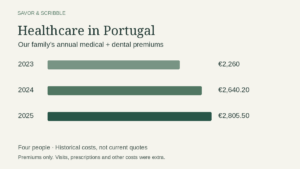
Here’s an area where Portugal really shines for our family. Our annual private health insurance premium is about €2,500, plus approximately €220 for dental coverage. That works out to roughly €227 per month in premiums for our family. We also have access to Portugal’s public healthcare system.
And while private insurance doesn’t make every medical expense disappear, we’ve found healthcare and prescriptions much more approachable here than what we were accustomed to in the US. We all have occasional medical needs, prescriptions, or appointments. For example, I’ve used asthma inhalers and other medications, and I’ve tried GLP-1 medications. Some of the drug prices have genuinely surprised me.
I previously paid around €10 for a box of Ozempic under my particular circumstances. More recently, Mounjaro has cost approximately €189 for a low-dose pen. Those aren’t universal prices, and coverage, availability, dose and individual eligibility can make a huge difference. But the overall experience of accessing healthcare in Portugal has been a major financial positive. I also see a chiropractor regularly on a €49-per-month plan.
Between health and dental premiums and that chiropractic plan, we’re budgeting approximately €276 per month, before variable prescriptions, copays and other out-of-pocket care. The important distinction is that this is not our complete medical spending. It’s the predictable portion. Still, compared with the anxiety that healthcare costs can create for Americans, particularly those retiring before Medicare age, Portugal has been a very welcome change.
Our Portuguese healthcare article covers more of our experience with insurance and getting care. The prescription prices above reflect particular purchases and circumstances; they aren’t a guide to whether a medicine is appropriate or what someone else will pay.
Utilities, internet and phones: about €480 a month
Our home is fully electric, and our electricity bill has been running close to €300 per month. We recently switched electricity providers from Endesa to EDP, where we’ve arranged a discounted tariff. I’m hoping that produces meaningful savings, but I’m not going to declare victory until we’ve received actual bills. Water costs approximately €30 to €50 per month. Our MEO package is about €140 per month.
That includes home internet, television, a sports package, three mobile phone lines, an Apple Watch connection and unlimited mobile data. For everything included, I think that’s pretty good value.
Our electricity usage is high, but that’s partly because we have a larger house, use electric heating and cooling, and enjoy keeping the home comfortable. The €300 household-electricity figure excludes the €90 allocated to charging the BYD, which is counted under transportation. Again, lifestyle choices.
If you’re comparing electricity contracts, ERSE’s official tariff comparison tool is a useful place to put your own usage figures to work.
Gym memberships: €150 a month
Leon and I each pay €75 a month for Holmes Place. It’s a nice gym with facilities we enjoy, and the kids can participate in quite a few activities without additional membership fees. Could we exercise for free?
Of course. Portugal has lovely walking paths, parks, beaches and plenty of places to move your body. But I like having access to a gym, swimming pool and other facilities. And at €150 per month for both adults, it’s a luxury we’ve decided to keep.
Subscriptions and all those little bills
You know what’s funny about retiring?
You stop getting a paycheck, but subscriptions do not stop finding you. We pay for Spotify Family, Netflix, iCloud storage, Amazon Prime, a password manager, a VPN and a few small online services. Together, these come to approximately €57 per month. Nothing outrageous individually. But the little monthly charges accumulate whether you’re working or retired. We also pay approximately €200 annually for a US mail-forwarding service.
Affiliate disclosure: I may earn a commission if you buy through the Surfshark links in this section.
For the VPN side of life abroad, we use Surfshark VPN (affiliate link). We’ve used it since moving to Portugal in 2022, and I love it. It’s helped us access the US websites and services we still need from here. Access varies by website, and some services block VPN connections. Check the terms of the service you want to use; a VPN doesn’t change account eligibility or verification requirements.
That allows us to maintain useful US mailing and package-receiving addresses while living abroad. And we still carry US life insurance policies, costing approximately €78 per month combined. These are the sorts of expenses that don’t always show up in those dreamy articles about retiring overseas.
The surprisingly expensive business of doing your taxes
Here’s one expense that retirement abroad definitely hasn’t eliminated. Accountants. Last year, our US tax preparation cost €1,116. Our Portuguese tax preparation cost another €1,230. That’s €2,346 annually, or roughly €196 per month when we spread it across the year. Not exactly thrilling spending.
But as US citizens living abroad, we have tax obligations in both countries, and we have investments and retirement accounts that make the situation more complex. I would much rather pay knowledgeable professionals than guess my way through an international tax situation. This is one reason that moving to a supposedly lower-cost country doesn’t automatically mean everything becomes cheaper. Some expenses simply change form.
The IRS explains the filing rules for US citizens abroad. For why the accounts you draw from matter as well as what you spend, see Retiring in Portugal With €2 Million: Why Your Investment Mix Matters.
The fun stuff: approximately €20,000 a year in travel
Here’s where the whole early retirement thing gets really good. Travel was one of our biggest motivations for moving abroad. Living in Portugal makes it easier to explore Europe, and we take advantage of that whenever we can. In the summer of 2026, we traveled through Italy, Switzerland and Croatia. We spent approximately €10,000 on that trip.
For Christmas, we’re heading to Barbados and Panama, with a projected trip cost of approximately €10,000 to €12,000. Yes, I realize that flying across the Atlantic to the Caribbean isn’t exactly making the most of our European location. But family, adventure and warm weather are compelling reasons to get on an airplane.
For the main budget table, I’m using a €20,000 annual travel allowance. Our €10,000 summer trip plus the €10,000 to €12,000 Christmas estimate could put those two trips alone at €20,000 to €22,000. If Christmas lands at the upper end, that’s another €2,000 for the year, or about €167 a month above the table’s allowance. Some years we’ll spend less. Other years, probably more. Could we cut our retirement spending significantly by traveling less?
Absolutely. Do we want to?
Not particularly.
We retired early because we wanted the freedom to enjoy our lives while we’re still relatively young and our children are growing up. Travel is a major part of that.
Everything else that sneaks into a family budget
There are always expenses that don’t fit neatly into a monthly spreadsheet. Kids outgrow shoes and clothes. Birthday party invitations seem to multiply. Something around the house needs servicing. This year, maintaining our home’s air-conditioning and heating units cost approximately €400. I get my hair cut and colored around three times annually, at about €130 per visit.
Leon gets regular haircuts, and the boys need theirs too. Plus occasional dreadlock maintenance. Grooming adds up to roughly €100 per month when averaged across the year. Then there are gifts. The kids attend birthday parties regularly, so we’re frequently buying €20 presents. And we have our own birthdays and Christmas to consider. I estimate around €1,440 per year for gifts, although it’s certainly possible for that number to grow.
We also occasionally hire a babysitter. One recent night out cost around €80 once we accounted for six hours of babysitting and dinner for the kids. Not a regular monthly expense, but it’s part of life. And I haven’t even included a dependable clothing budget, every possible home repair, all our medical expenses, or the depreciation on our car. Income taxes owed aren’t in this household-spending table either; the tax line covers preparation fees only.
Real life doesn’t fit perfectly into tidy categories.
Our cost of living in Portugal: the full budget
After converting annual bills into monthly averages and allowing for our typical travel spending, this is our approximate household budget.
| Expense | Monthly average |
|---|---|
| Housing, insurance and property tax | €2,575 |
| International school, registration and lunches | €2,275 |
| Kids’ activities | €303 |
| Groceries | €1,300 to €1,733 |
| Restaurants and takeaway | €433 |
| Transportation running costs | €207 |
| Healthcare premiums and chiropractor | €276 |
| US life insurance | €78 |
| Electricity, water and MEO | €480 |
| Gym | €150 |
| Subscriptions | €57 |
| US and Portuguese tax preparation (fees only) | €196 |
| US mail forwarding | €17 |
| Grooming | €101 |
| Gifts | €120 |
| HVAC maintenance allowance | €33 |
| Travel allowance | €1,667 |
| Total | About €10,300 to €10,700 |
Using the underlying figures before rounding, the listed costs total approximately €123,200 to €128,400 a year, or €10,267 to €10,700 a month. I’ve rounded the headline monthly range to the nearest €100. A €22,000 travel year would add €2,000 to either end of the annual range. And here’s a useful reality check. Our international school costs more than €27,000 annually. Travel adds another €20,000.
That’s approximately €47,000 devoted to just those two categories. A family choosing public schools and a much smaller travel budget could have a dramatically different cost of living. Our budget isn’t a statement about what someone needs to live in Portugal. It’s a statement about what we spend. And that distinction matters.
Is Portugal actually cheaper than America?
For us, the answer is complicated. Housing? Not dramatically cheaper. Our mortgage is in roughly the same ballpark as what we were paying in Washington. Education? More expensive for us, because we would probably have chosen public schools in the United States. Healthcare? A substantial improvement in affordability and predictability. Mobile phones and communications? Excellent value for what we get.
Car charging and some transportation costs? Very reasonable. Groceries? They can be affordable, especially if you shop carefully, although our own food spending is hardly an advertisement for extreme frugality. Travel? Being based in Europe opens up options we didn’t have as easily from the Pacific Northwest. But our travel spending reflects how much we’ve chosen to travel, not just what flights cost.
So no, I can’t tell you that we moved to Portugal and instantly slashed our expenses in half. We didn’t. We also never set out to do that.
What financial independence means to us now
When we were working toward financial independence, the numbers were everything. Saving. Investing. Watching our portfolio grow. Figuring out when we could finally stop working. And those numbers still matter. But once you’re actually retired, the questions change. Is the money helping us live the life we wanted?
Are we using our time well?
Are we making choices because they genuinely improve our lives, or simply because we’ve become accustomed to spending money on them?
I look at our international school bill and wonder what that money could become if we invested it. I look at our mortgage and wonder whether paying it off would simplify our lives. I look at our travel spending and think about all the places we still want to see with our boys. And sometimes I look at our grocery bill and wonder whether everyone in this house has secretly developed a second stomach. The point is, we still think about money.
Retiring early doesn’t mean you stop making financial decisions. It means you have the freedom to make more of them on your own terms. I’m quite happy to leave the competition for the cheapest retirement to somebody else. We’re trying to make our money support a life we’re excited to wake up to. And for now, that life happens to be in Portugal.
If you’re curious about how we reached this point, start with our FIRE story and how we approached budgeting and investing for FIRE. Our current spending is not a withdrawal-rate recommendation or a claim about the portfolio another family needs.
Would we do it again?
Yes. Not because Portugal is a magical place where everything is cheap. It isn’t. And certainly not because our version of life here is inexpensive. But we have a comfortable home, our children are growing up in an international environment, we can travel, we have access to healthcare we can afford, and we get to spend more of our time together. Four years after moving here, those things still feel worth it.
If you’re considering retiring in Portugal, my advice is simple: don’t build your budget around someone else’s lifestyle. Especially not ours. Think about the home you’d want, the schools your children might attend, how often you want to travel, what kind of healthcare you need, and the everyday comforts you’re unwilling to give up. Then build a budget around that.
I’d start by asking, “What will the life I actually want cost me?”
Thinking about moving to Portugal?
We moved from the US to Portugal in 2022 after achieving financial independence, and we’ve learned a lot about what the move looks like beyond the glossy Instagram photos. I offer one-hour consultations for €95 where we can talk through the practical side of moving, from neighborhoods and schools to banking, housing and what daily life actually looks like.
I’m not a tax adviser or immigration lawyer, but I’m happy to share what we’ve experienced, what surprised us, and what I wish we’d known before moving.
Book a 60-minute Portugal consultation for €95
And I’m curious: Which of our expenses surprised you most? The international school bill? Our grocery spending? Or the fact that you can apparently spend six figures a year living in a country famous for its affordability?
I’d love to hear what you think.
About the numbers: These figures come from our household expense sheet and estimates discussed in November 2026. Annual bills are divided by 12; weekly food spending is multiplied by 52, then divided by 12. School tuition and lunches are billed across ten months but averaged across twelve here. The main table uses €20,000 for travel; the two trips described could total €20,000 to €22,000. This isn’t an audited record of every euro spent. Car purchases and depreciation, clothing, some medical costs, repairs, miscellaneous shopping, occasional babysitting and income taxes owed are not fully reflected. The mortgage figure includes the whole payment, including principal, so this is a cash-flow budget rather than a measure of consumption. Our previous healthcare article describes earlier premiums; these are the estimates used for this November 2026 budget. Prices and insurance terms are personal examples, not quotes or promises for another household.
This is our family’s experience and general information, not individual financial, tax, legal or medical advice. Check current requirements and personal decisions with the relevant authorities and qualified professionals.
Planning a move to Portugal?
Get my free six-page Moving-to-Portugal Checklist by email. Decisions, documents and the practical details, all in one place. See what’s inside.
Confirm your email to receive the PDF. Future articles and consultation offers are optional.